

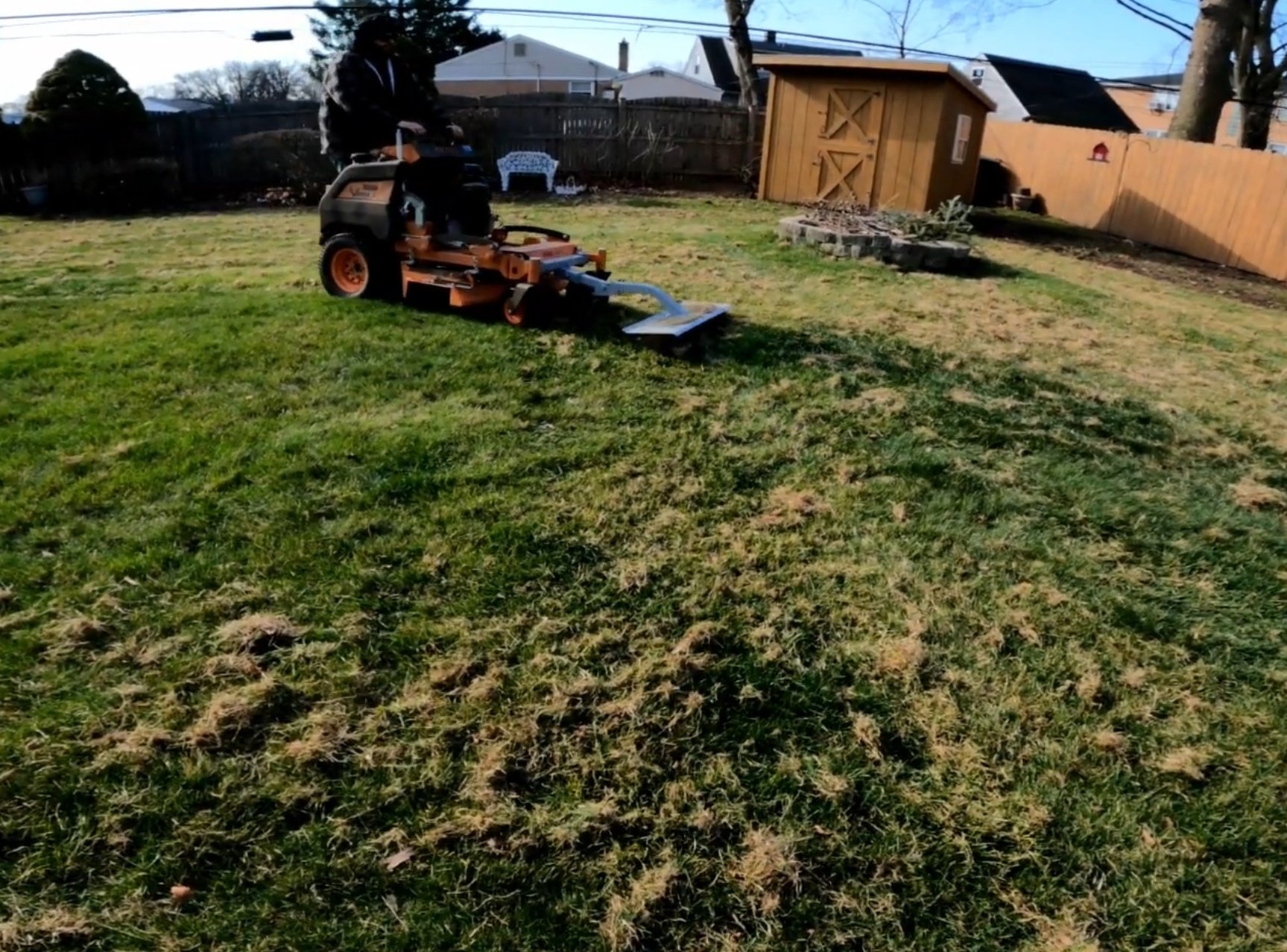
Lawn Dethatching & Power Raking in Gurnee, IL
Excessive thatch buildup? Spongy turf? A thick layer of material above the soil?
Evo Lawn & Landscape provides residential lawn dethatching and power raking in Gurnee, Illinois, when excessive thatch actually needs mechanical removal.
We review the lawn before recommending dethatching. A normal thatch layer does not automatically need to be removed, and aggressive equipment can disturb healthy turf.
Call or text: 224-777-0061
Does Your Gurnee Lawn Actually Need Dethatching?
Not every lawn needs mechanical dethatching. Some thatch is normal. The concern is excessive accumulation that affects healthy turf growth.
Less Than ½ Inch of Thatch
A relatively thin layer can cushion the turf and does not automatically justify aggressive mechanical removal.
If the lawn is otherwise healthy, routine dethatching may offer little benefit.
Excessive Thatch Buildup
A dense thatch layer greater than roughly half an inch may interfere with roots, moisture movement and normal lawn management.
We evaluate whether that buildup is significant enough to remove.
Measure Before Removing
A small turf-and-soil plug can help show the brown organic layer between the green grass and the soil.
We consider thickness, turf health and recovery before recommending the service.
Illinois Extension guidance: Thatch less than approximately half an inch can be beneficial. Excessive buildup above that level may justify management, but mechanical removal is disruptive and should be recommended carefully. Read the Extension guidance.
What Lawn Thatch Actually Is
Thatch is a layer of living and dead roots, stems and other organic material located between the growing grass and the soil surface.
The layer develops when turf material accumulates faster than it naturally breaks down.
A healthy lawn can have some thatch without needing mechanical removal. Problems develop when the buildup becomes excessive.
Grass Clippings Are Not Usually the Cause
Properly mowed grass clippings contain substantial moisture and generally decompose quickly. Thatch develops mainly from slower-decomposing roots and stems.
Signs Worth Investigating
- Thick brown material beneath the grass
- Spongy turf unrelated to wet soil
- A dense layer visible in a soil plug
- Heavy recurring surface buildup
- Weak turf growing above a dense layer
- Roots concentrated in thatch rather than soil
These signs warrant inspection. They do not independently prove dethatching is required.
What Causes Excessive Thatch in Gurnee Lawns?
Removing thatch without addressing why it accumulated may allow the problem to return.
Excessive Fertilization
Too much nitrogen can encourage rapid turf growth and contribute to organic material accumulating faster than it decomposes.
Overwatering
Frequent excessive watering can encourage unnecessary growth and create conditions that contribute to thatch buildup.
Compacted Soil
Compacted soil can limit healthy root-zone conditions. Core aeration may be more directly appropriate when compaction is the main concern.
Heavy or Wet Soil
Poorly drained or persistently wet soil can contribute to conditions that slow organic material breakdown.
Soil Chemistry
Alkaline or high-pH soil conditions may contribute to problems with natural decomposition.
Slow Organic Breakdown
Thatch develops when the production of roots and stems exceeds the rate at which soil organisms break them down.
How Our Gurnee Lawn Dethatching Service Works
Dethatching is corrective lawn work, not ordinary weekly maintenance. The final scope depends on the property's condition.
Lawn Inspection
We review turf density, thatch thickness, soil conditions, access and whether the lawn can tolerate mechanical work.
Service Recommendation
We determine whether dethatching is appropriate and discuss the equipment and approved lawn areas.
Mechanical Dethatching
Approved turf areas are mechanically worked to loosen and pull excessive thatch toward the surface.
Material Collection
Loosened organic material is collected from the approved lawn areas according to the quoted service scope.
Property Cleanup
We address agreed work areas and approved hard surfaces affected during the dethatching process.
Lawn Recovery Plan
We discuss recovery, aftercare and whether other work is appropriate once excessive thatch has been removed.
What about debris? Dethatching can bring a substantial amount of organic material to the surface. The approved estimate defines collection, cleanup and any additional handling requirements.
Lawn Dethatching vs. Core Aeration
These services are not interchangeable. The correct choice depends on where the problem is located.
Lawn Dethatching / Power Raking
Mechanical dethatching loosens and removes excessive accumulated organic material between the green turf and the soil surface.
- Targets problematic thatch
- Uses mechanical dethatching equipment
- Can temporarily thin or disturb turf
- Requires appropriate recovery conditions
Core Aeration
Core aeration removes small plugs of soil using hollow tines. It is primarily considered when compacted soil is limiting root-zone conditions.
- Targets compacted soil
- Removes soil cores
- Creates temporary openings in the lawn
- Does not replace actual heavy-thatch removal
Which service should you choose? If a lawn has compacted soil without excessive thatch, core aeration may be the better service. If the lawn has an excessive organic layer above the soil, dethatching may be justified. Both can sometimes be appropriate, but not automatically.
Best Time to Dethatch a Lawn in Gurnee
Mechanical dethatching should be considered when cool-season turf has enough favorable growing conditions to recover.
Late Summer Into Early Fall
University of Illinois Extension identifies late August as a favorable period for aggressive thatch removal on cool-season lawns because there is time for recovery and possible reseeding.
Spring Dethatching
Spring may also be considered when excessive buildup actually requires removal and the lawn is actively growing.
We do not recommend dethatching solely based on the calendar. Actual thatch buildup and recovery conditions come first.
When We May Recommend Waiting
- Turf is stressed by severe heat
- Extended drought conditions
- Soil is saturated or excessively wet
- Grass is already severely weakened
- Recovery time is limited
- Thatch buildup is not actually excessive
Timing and property suitability are reviewed before service is confirmed.
When We Would Not Recommend Dethatching
Aggressive dethatching should have a clear purpose. It is not the solution to every weak lawn.
Normal Thatch Layer
Healthy turf with a relatively thin thatch layer does not automatically require mechanical removal.
Compacted Soil
Where compaction is the primary issue and excess thatch is absent, core aeration may be more appropriate.
Heavy Shade
Removing thatch does not correct insufficient sunlight or a site that cannot support turf.
Poor Drainage
Dethatching does not replace drainage or grading correction when standing water is the underlying issue.
Extremely Weak Turf
A severely stressed or damaged lawn may lack the strength to recover from aggressive dethatching.
Grass Clippings Alone
Ordinary mowing clippings do not prove a thatch problem and are not a reason by themselves to recommend dethatching.
How Much Does Lawn Dethatching Cost in Gurnee, IL?
Residential dethatching with Evo Lawn & Landscape starts at $200 for qualifying properties.
Final pricing increases with the actual lawn area, amount of thatch, equipment access and cleanup workload.
Any separately requested core aeration, overseeding or starter fertilizer is quoted as an optional add-on.
Request My Gurnee Dethatching Price →What Affects Dethatching Pricing?
- Total lawn area being serviced
- Amount and density of thatch
- Equipment access and property layout
- Gates, slopes and obstacles
- Material collection workload
- Approved cleanup requirements
- Lawn condition and necessary passes
- Optional additional services
We confirm the approved work scope and final price before scheduling the service.
What Happens to Your Lawn After Dethatching?
Mechanical dethatching can make the lawn look thinner or rougher immediately after the work. That is why we consider recovery before recommending the service.
Temporary Lawn Disruption
Dethatching may remove weak grass along with excessive organic material. A freshly dethatched lawn may not look finished immediately afterward.
Address Why Thatch Developed
Overfertilization, excessive watering, compaction and drainage issues can contribute to recurring buildup. Removing material alone may not correct the cause.
Overseeding May Be Appropriate
When aggressive removal leaves turf thin, overseeding can be considered as additional recovery work if the season and lawn conditions are suitable.
Learn about Gurnee overseeding →Dethatching is the primary service. Overseeding is only an optional follow-up when appropriate. It is not automatically included in the starting dethatching price.
Lawn Dethatching for Gurnee Homeowners
Residential lawns throughout Gurnee can have different soil conditions, turf species, watering routines and growing histories.
Properties near Hunt Club Road, Washington Street, Grand Avenue and other Gurnee residential areas may need different lawn recommendations.
We review the actual property and thatch condition instead of assuming every lawn needs power raking.
Explore our Gurnee lawn and landscape services for other residential property care options.
Request My Property Review →What We Review at Your Property
- Existing turf density
- Thatch thickness
- Condition of the underlying soil
- Whether the lawn is actively growing
- Irrigation and underground obstacles
- Gates, fencing and equipment access
- Amount of loosened material expected
- Suitable time for turf recovery
Choose the Right Service for Your Gurnee Lawn
Dethatching targets excessive thatch buildup. These related services address different lawn conditions.
Core Aeration in Gurnee
Learn about relieving compacted soil through mechanical core aeration.
Gurnee core aeration service →Gurnee Lawn Overseeding
Review grass seeding for thin turf when soil conditions and timing support new growth.
Lawn overseeding in Gurnee →Lake County Dethatching
Explore the broader residential dethatching and power raking service overview.
Lake County dethatching service →Gurnee Lawn Maintenance
Routine residential lawn care during the growing season.
Gurnee lawn maintenance →Gurnee Lawn Mowing
Weekly lawn mowing for qualifying residential properties.
Gurnee lawn mowing service →All Gurnee Services
Browse residential lawn and landscaping services for Gurnee homeowners.
Gurnee service hub →Lawn Dethatching FAQs
Answers about power raking, thatch thickness, timing, lawn recovery and pricing.
How much does lawn dethatching cost in Gurnee, IL?
Evo Lawn & Landscape's residential dethatching starts at $200 for qualifying properties. Final pricing depends on the lawn area, amount of thatch, equipment access, collection and cleanup workload.
How do I know if my lawn needs dethatching?
Inspect the layer between the green turf and soil. A dense layer of thatch greater than roughly half an inch may need management. We consider its severity and the health of the lawn before recommending removal.
How much lawn thatch is too much?
Illinois Extension explains that a thin layer under approximately half an inch can be beneficial. Excessive buildup beyond that thickness may begin interfering with normal turf health.
Is lawn dethatching the same as power raking?
The terms are often used together for mechanical thatch removal. Power raking can describe a more aggressive approach, while dethatching describes the broader goal of removing excess material. The method depends on the lawn.
Do grass clippings cause thatch?
Properly mowed clippings are not normally the primary cause of thatch. Thatch develops mainly from stems and roots that accumulate faster than they decompose.
Is dethatching the same as core aeration?
No. Dethatching removes excessive surface organic material, while core aeration removes soil plugs and is commonly considered for soil compaction.
Should I aerate or dethatch my lawn?
That depends on the problem. If your lawn has excessive thatch, dethatching may be appropriate. If the soil is compacted without heavy thatch, core aeration may be more useful.
Can dethatching damage my grass?
Yes. Mechanical dethatching can pull out weak turf and disturb healthy grass. It should be performed only when the expected benefits justify the disruption and the lawn can recover.
Will my lawn look worse after dethatching?
It can. Mechanical removal may temporarily leave turf thinner or rougher. Recovery depends on the existing grass, weather, soil conditions and any additional work needed.
What is the best time to dethatch in northern Illinois?
Dethatching is generally considered when cool-season turf is actively growing. Illinois Extension recommends late August for aggressive thatch removal because the period can support recovery and potential reseeding.
Should my lawn be dethatched every year?
Not necessarily. Dethatching should address excessive buildup, not follow an automatic annual schedule when the lawn does not need the work.
Does dethatching include cleanup of the removed material?
Our approved dethatching scope includes collection of material loosened from the serviced areas and cleanup of agreed work areas. Final handling and additional requirements are specified in the quote.
Should I overseed after dethatching?
Sometimes. Aggressive dethatching may thin existing turf, making overseeding worth considering. It is a separate optional service, and establishment depends on timing, soil contact and watering.
Do you provide residential power raking in Gurnee?
Evo Lawn & Landscape provides residential lawn dethatching and power raking for qualifying properties in Gurnee, IL 60031. We review the property before confirming the service.
How do I request a dethatching quote?
Complete our Gurnee dethatching quote form with your address and lawn details, or call or text 224-777-0061 .
Need Lawn Dethatching in Gurnee?
Let us review the lawn and determine whether excessive thatch needs mechanical removal. Residential service starts at $200 for qualifying properties.
